Dealing With Drought

Dealing With Drought
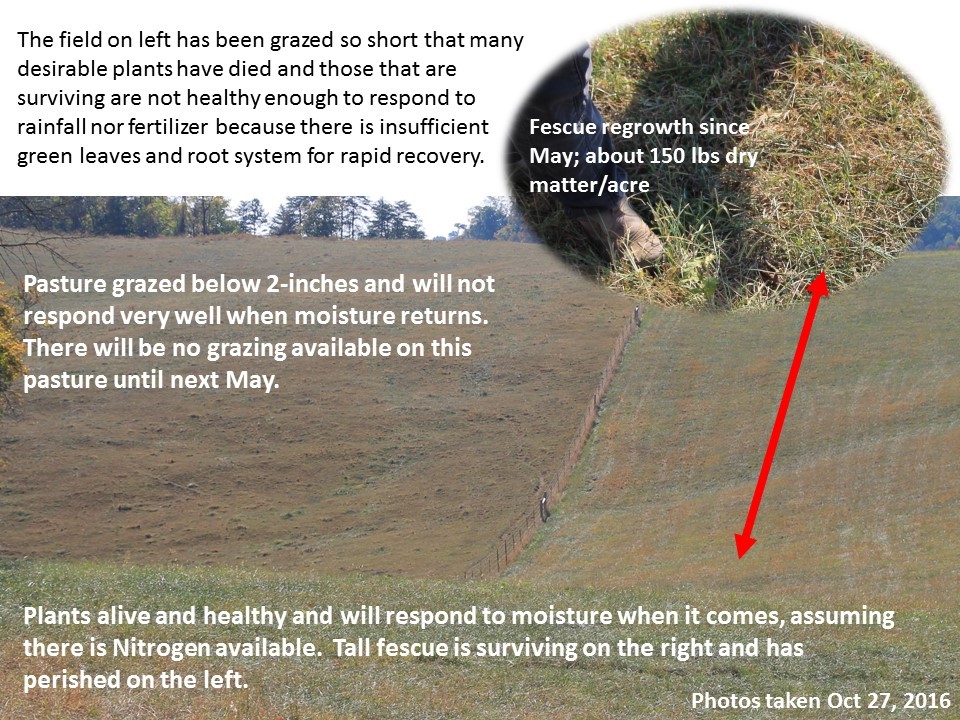
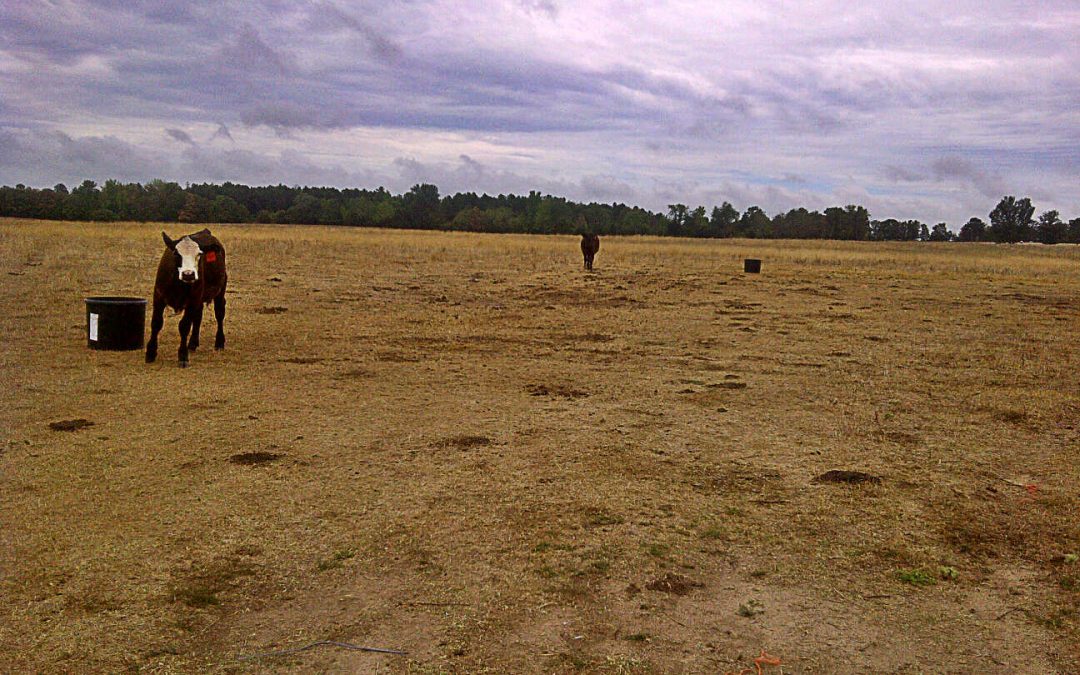
During droughts it is tempting to graze all pastures and to graze them short, however,  short grazed pastures provide almost no feed and leaves many plants dead and others in such a weakened condition that they cannot respond well when conditions return.  In the long run, it’s best to start feeding hay in a small portion of the farm any time grass is grazed to about 2-4 inches so that those plants will be in better health for regrowth following the stress period.  Cattle cannot take enough bites in 12 hours of grazing to meet their needs when the pasture is less than about 3 inches height….so you may as well feed hay to meet their needs and protect the pasture.

The following considerations are based on the situation found on many livestock farms in East TN as of this week.  Pastures have been completely used and hay has been fed for several weeks by many producers.  The “surviving” vegetation in many pastures include bermuda, dallisgrass, grease grass (called purple top), broomsedge, nimble will, and  various “weedy” types such as horsenettle, thistle, yellow crown beard, chicory.  There is some possibility that tall fescue, orchardgrass and bluegrass will survive where they have not been grazed below 2-inches for long periods of time.

Considerations for the next few weeks that might help address short term feeding expenses and provide forage in late winter and early spring of 2017.

  1. Cull any cows that are not healthy or in poor condition or that are calving outside of a narrow calving window that fits with most of the herd.
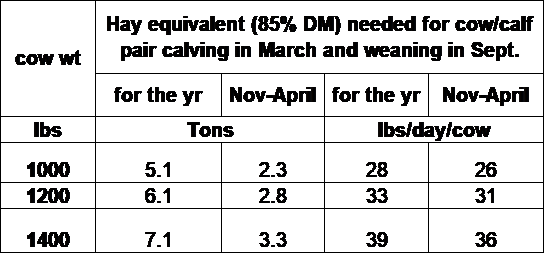
    1. Consider that it takes about 16-35 lbs of good hay per day to feed a dry cow, and it will take more nutrients to feed a nursing cow or growing animal. Review Table 1 for effects of cow size on feed needs (assuming suitable forage quality).
    2. If drought and overgrazing has left only warm season plants surviving there will be virtually no grazing until next May. This means 6-7 months of feeding stored feed at $1-$1.50/ head/ day, plus labor and fuel.
    3. Cattle prices are not likely to improve over the next few weeks/month therefore “holding on” for better prices is probably not a “good bet” in this situation. 
  1. Sell weaned calves soon since prices have been dropping recently and are not likely to improve enough to cover additional feed cost that will be needed to keep them growing properly.


  1. If tall fescue or orchardgrass and bluegrass make up less than 50% of the pasture acreage, strongly consider no-till planting them as soon as possible, but before end of November. It is likely that 25-40 lbs N/acre will insure the seedlings can develop sufficiently this winter.  Remember that the normal planting dates are before mid-October, but if you have no surviving cool season grasses it might be worth a “gamble” to get some acreage planted.  Otherwise, there will be no cool season grasses on the farm next year.  In most years, spring planting of cool season grasses is much more risky than planting in late fall.  Do not plant annual ryegrass with these species as it will be very competitive and you will be “tempted” to graze it early next spring.  Do not plan to graze any cool season grass seedlings until next April or May when it reaches more than 8 inches of growth.


  1. To have a significant chance for late winter-early spring grazing, consider planting small grains with annual ryegrass in pastures that are currently mostly covered with bermudagrass and dallisgrass or dead crabgrass or pasture with a thin stand of tall fescue. The odds are that one can expect 2000 to 4000 lbs of forage if good stands are obtained and Nitrogen rates are at 100 lbs/acre or so.  This means adding 25-40 lbs of N next month and another 50-75 lbs/acre in March or April.  Count the cost as compared to alternative feeds.  Next fall August 15 to October 1 consider drilling in perennial cool season forages.


  1. The most consistent stands are usually obtained from drilling as compared to broadcasting on the surface of the soil, especially in the autumn-fall period. Seeding rates can usually be about 25-50% less when drilled as compared to broadcasting the seeds on soil surface.  When planting late it is often worthwhile to plant slightly more seeds per acre as compared to planting “on time”.


  1. In the future consider the cost of re-establishing a pasture vs the start of feeding hay a few weeks earlier than normal. University budgets indicate costs ranging from $50 to $200 depending on the soil fertility status, and type of replanting and species being established.  In addition, pastures that are less than 4 inches tall does not provide more than a 100-300 lbs of forage per acre that can actually be consumed ( this is less than 1/3 of a normal round bale of hay).  In addition most cows will lose weight when forced to graze such short grazed pastures.


  1. Hay quality may be marginal in some cases, therefore it will be worth a few dollars to get a feed test to determine if supplemental energy or protein will be needed to meet animal requirements. As a general rule, energy will be the most limiting factor so be cautious about just using protein supplements without knowing composition of hay or other feeds.


  1. Corn gluten feed may be one of the most economical alternatives, especially since it has high protein and energy level. However, pay attention to the price per lb. of dry matter.  Some by-products have significant amount of water in them.


  1. Graze residual growth in hay fields but do not graze below 2” in the winter. Remove cattle if pastures are prone to pugging (muddy and trampling of vegetation).  Rationing standing grass with temporary fence will improve grazing utilization.


  1. Crop residues may be a good option if properly supplemented with energy and/or protein as needed. However, removing more than 50% of the residue from the cropland can result in soil erosion and much less water infiltration, which can result in more drought stress in the future.

 Table 1.  The effect of cow weight on forage needed for the year and winter feeding period.
Alternatives to Help Stretch Forage Supplies

Alternatives to Help Stretch Forage Supplies

Maintain a 3” minimum grazing height


Inventory Animal Demand and Forage Supply

  • Animal demand per 1,000 lb cow is roughly 20 -30 pounds of forage per day, 750 - 900 pounds forage/month or 9,000 - 10,800/year demand will be somewhat less for non-lactating animals and somewhat higher for lactating animals. Best to allow for 10% forage wastage. Most operations feed hay for a 90 days or more. Real good grazers or low stocked operations feed less days. On average producers feed hay 120 days. Example: 120 days x 30 pounds = 3600 pounds/cow + 360 pounds waste = 3960 pounds hay/cow/winter feeding of 120 days
  • Inventory grass, hay or other feed supply before April 1, July 1 and Oct. 1.
  • Inventory pasture - every acre-inch of forage is equal to 200 – 400 pounds of dry matter. A good average is 300 pounds/acre inch for good producing grass. Example: 5” of growth x 300 pounds/acre in = 1500 pounds of forage but typically livestock only consume around 50% of that so 750 pounds per acre.

As few as two or three plants per square feet with good stem diameter should rebound and make a good stand with good management and adequate moisture.  If the pasture is grazed for an extended time below 3”, the pasture will likely need re-seeding.

  • Some producers like to have a 20% carryover of hay for insurance in case of a long winter, extended drought, hay fire, etc.
  • Example: 20 head cows x 3960 pounds for 120 days = 79,200 pounds/20 head cow herd. If rolls of hay weighing 1,000 pounds and have not weathered much, this producer would need 79 or 80 rolls per winter. Twenty acres x 750 pounds/acre = 15,000 pounds of forage which would last about 25 days if 20 head were grazing and no additional growth occurred. (20 head x 30 pounds/day = 600 pounds forage demand)


Options to Stretch Forage Supply

If additional forage is needed one or a combination of the following alternatives could improve forage utilization and/or production.

  • Best to restrict animals to one paddock (field) until other paddocks re-grow otherwise all paddocks will be grazed so low that recovery is very slow and grass may even be killed. Another option is to continue to rotating animals on a schedule of 7 days or less.
  • When forage re-grows to five inches or taller allow animals access to four days or less of forage at a time will typically increase forage utilization by 20% or more.


  • Stockpiling tall fescue - setting aside 0.5 to 1 acre per cow extends grazing and provides higher quality grazing. Many producers stockpile tall fescue without fertilizing with nitrogen this is a consideration especially when fertilizer prices are high. Consider the following; fertilizing tall fescue with 60 pounds of Nitrogen (180 pounds of ammonia nitrate) will produce an additional ton of forage. Cost of Nitrogen at $0.40/pound of nitrogen x 60 pounds or nitrogen will cost $24/acre.If hay cost $24/1,000 pound roll a producer will produce 1,000 pounds of forage in addition to the cost of 1000 pound roll.. Some of the standing grass will be wasted due to trampling and manure damage. Depending on forage management, cattle will consume 50 to 70% of the 1,000 pounds providing a benefit of an additional 500 to 700 pounds above cost of nitrogen. Benefits may even be greater if hay waste is high.
  • Over-seeding pastures with winter annuals. Typically not feasible to overseed pastures with winter annuals unless tall fescue stand is less than 50%, even then, it is questionable but in an emergency, it is an option. Spring oats provide the quickest growth in the fall but die out during the winter. Winter oats are another option. Seed 4 bushels of oats by Oct 1. Rye is second quickest growth, seed 2-3 bushels/acre prior to October 15 for fall growth. Wheat seed 2-3 bushels/acre by October 1. Ryegrass generally just provides late winter quality forage the same time that tall fescue is growing. Fertilize winter annuals with a minimum of 45 pounds of nitrogen per acre.
  • Consider leasing additional pasture
  • Grazing fields traditionally used for fall hay, this is particularly a good option when you consider harvest efficiency of harvesting hay is typically 70% and strip grazing also has an efficiency of 70%. You get the same utilization for less cost! If land is not strip grazed, utilization will likely be at 50% efficiency. High fuel cost makes grazing hay fields in the fall the best option.
  • Early weaning will reduce stress on the cow and extend forage supply
  • Creep grazing Allowing calves access to higher quality forage than the cows. A demonstration farm in Bledsoe County creep grazed calves gained an additional 75 pounds grazing pearl millet in the summer. Winter annuals are a good option for creep grazing in the cool months. Some producers place their electric wire at about 30” above the ground to allow calves to free range choosing the best forage ahead of the cows. When weaned calves are grazing an adjacent pasture field to the mother cow, there is naturally less stress for both. Cows in better condition breed back sooner.
  • Feed ruminant friendly by products such as soyhulls, and corn gluten.
  • Irrigation, can improve forage production, it is important to have optimum stand, weed control, fertility, for irrigation to pay.
  • Adjust stocking rate, some producers like to stock for drought not high production, approximately 20% below maximum stocking rate. Plan for the worst scenario & hope for the best!


Management Strategies ahead of drought

  • Diversity of forages 70 % cool season, 30 % warm season. Different species within each group or season of forage can extend the growing season.
  • Multiple paddocks (cross fence to make five or more fields).
  • Proper grazing heights - A recent study at North Carolina State University showed that overgrazed pastures produced 37% less than pasture grazed to a 3” height.
  • Stockpiled forage- provides quality forage at the lowest cost
  • Maintain fertility utilizing soil test
  • Evaluate forage supply – Determine needs in advance with the end of seeding dates in mind. April 1 for spring seeded cool season grasses, July 1 for warm season grasses and October 1 for fall seeded cool season grasses.